
Construction Team
Members
- General Contractor (Team Lead)
- Subcontractors
- Independent Contractors
- Vendors
The General Contractor typically leads the Construction Team.
In many projects, the owner hires a general contractor who then hires and manages subcontractors.
In smaller projects, owners may contract directly with subcontractors.
Role Definitions
General Contractor
Responsible for constructing the overall project, coordinating trades, managing schedules, and paying subcontractors and vendors. The general contractor invoices the owner according to contract terms and typically includes overhead and profit.
Subcontractor
Contracts with the general contractor to perform a specific trade. Subcontractors provide labor and materials within their defined scope of work.
Independent Contractor
Contracts directly with the owner and may perform one or more trades without subcontractor agreements.
Vendor
Supplies materials or equipment. Vendors invoice according to agreed terms.
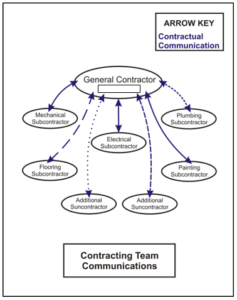
Contractual Communication Structure
The Construction Team does not operate as one unified company.
It operates as a network of separate contracts.
In most projects, subcontractors do not contract directly with the owner.
They contract with the general contractor.
That structure shapes communication flow.
Strong contractual lines create direct responsibility.
Weaker lines create indirect communication.
When owners bypass structure and communicate directly with subcontractors, confusion and liability gaps can occur.
Clear contractual pathways protect coordination.
Objectives
The Construction Team aims to:
- Win the project
- Complete it efficiently
- Protect profit margins
- Reduce liability
Contractors cannot operate without winning jobs.
Once awarded, their financial success depends on how closely actual costs align with their bid assumptions.
When projects run smoothly and predictably, everyone benefits.
When assumptions are unclear, tension increases.
Common Issues
Once under contract, contractors manage profit through operational decisions.
These may include:
- Improving efficiency
- Managing labor time
- Coordinating trades tightly
- Controlling material costs
- Managing payment timing
Shortcuts that reduce quality are unacceptable.
Efficiency that maintains standards is professional practice.
Cost savings through value engineering can benefit the owner — if transparent.
Profit protection becomes problematic only when scope clarity is weak.
Ambiguity creates opportunity for dispute.
Clarity reduces it.
Time is a major cost driver.
When work finishes faster than anticipated, profit increases.
When delays occur, margins shrink.
This creates pressure during construction that owners must understand.

TIP: Understanding how contractors operate helps you anticipate behavior during Bidding and Construction.
Continue Exploring the Teams
You may also review:
Or return to the main Project Teams page.