
Develop Your Schedule
The Project Schedule is the fourth and final major part of your Project Plan.
Your Project Schedule helps you organize and think through how long your project should take.
Most owners naturally begin with two questions:
When can we start?
When will we be done?
Sometimes there is already a date in mind — a move, holiday, lease expiration, event, or simply the desire to get the project finished as quickly as possible.
That date can feel like a plan.
It isn’t.
A realistic completion date comes from understanding what has to happen, in what order, and how long those activities reasonably take.
At the beginning of the project, one of the most important things you can do is make sure you give yourself enough time.
TIP: Time can be your friend, or it can become your enemy. If you plan the project far enough ahead, you can control the project, but if you shoot from the hip, you’re always under the gun.
When time gets tight, options disappear. Decisions become urgent, bidding and negotiation get compressed, and normal problems suddenly feel like emergencies.
Time pressure changes the way you make decisions.
A realistic schedule gives you time to think instead of simply react.
Choosing the Right Schedule Format
Not every project needs a Gantt chart.
If your project has only a few activities or trades and the sequence is easy to understand, a simple list showing activities, durations, and dates may be all you need.
As projects become more complex, the relationships between activities become more important. Multiple trades may overlap, inspections may control when work can continue, and a delay in one activity may affect several others.
When those relationships become difficult to understand or manage in a simple list, a Gantt chart becomes useful.
The Gantt Chart
A Gantt chart is a visual linear calendar that shows where activities happen across time.
Figure 6. Gantt Chart Example
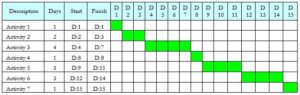
A Gantt chart contains a list of activity descriptions with their durations and Start and Finish dates. Horizontal bars show when each activity occurs and how long it lasts. The position and length of each bar correspond to the dates shown across the top of the schedule.
Activities can also be related to one another. Those relationships determine when following activities can begin or finish. Common relationships include:
- Start-to-Start
- Start-to-Finish
- Finish-to-Finish
- Finish-to-Start
And these can all have positive or negative lag, which is the time between relationships
You do not need to become a professional scheduler to create a useful Project Schedule. You need to understand the activities required for your project, put them in a logical order, determine approximately how long they should take, and give yourself enough time for the project to unfold realistically.
TOOLBOX
🧰 Use the Project Schedule form in the Toolbox at ConstructionConductor.com.
🧭 What Comes Next
Next, you will build your Project Schedule.
You will:
- Give yourself enough time to plan the project.
- Allow time for bidding and negotiation.
- Identify the major construction activities and put them in a logical sequence.
- Determine how long those activities should take.
- Account for delays, lead times, inspections, weekends, holidays, and other constraints that can affect the schedule.
- Review the completed schedule to make sure it is realistic and coordinated with your Scope of Work and Project Budget.
The goal is not to predict every day of the project perfectly. It is to create a realistic plan for how the project should progress and give yourself the time you need to manage it successfully.