
Project Delivery Methods
How a project is structured determines how control, communication, and pricing function.
Contract structure is not cosmetic.
It shapes incentives.
It influences transparency.
It determines where leverage lives before pricing begins.
Three common delivery structures dominate residential construction:
- Design–Bid–Build
- Design–Build
- Owner’s Agent
Each organizes authority differently.
Those differences matter under pressure.
Design–Bid–Build
(Most Common Delivery Structure)
Design–Bid–Build separates design and construction into distinct contracts.
The owner contracts first with the designer.
When design is complete, contractors competitively bid the work.
The owner then contracts separately with the selected contractor.
This separation creates natural checks and balances.
The designer protects design integrity.
The contractor protects execution efficiency and margin.
The owner sits between them.
When documentation is complete and scope is clear, this structure works well.
When documentation is incomplete, the separation amplifies friction.
Gaps in drawings become pricing discrepancies.
Ambiguities become change orders.
Communication shifts under pressure.
Design–Bid–Build depends heavily on disciplined Planning and complete documentation.
It rewards clarity.
It punishes vagueness.
Design–Build
(Single-Contract Structure)
Design–Build combines design and construction under one contract.
The owner contracts with one entity responsible for both design and execution.
This simplifies contractual relationships.
Communication flows through a single channel.
Coordination happens internally.
Visible conflict between designer and contractor decreases.
Authority concentrates.
Because pricing and design evolve together, cost decisions and design decisions occur simultaneously.
This can increase speed.
It can also reduce pricing transparency.
Under financial pressure, internal trade-offs between cost and quality may not be fully visible to the owner.
Design–Build reduces external friction.
It does not eliminate structural trade-offs.
Owner’s Agent
(Independent Oversight Structure)
The Owner’s Agent structure adds an independent professional whose sole obligation is to the owner.
The owner contracts separately with:
- The Design Team
- The Construction Team
- An independent Owner’s Agent
The Owner’s Agent does not perform design or construction.
They manage alignment.
This structure preserves:
- Competitive bidding
- Separation of design and construction
- Independent oversight
Because no single entity controls both design and execution, structural checks and balances remain intact.
It increases transparency.
It also requires discipline and engagement from the owner.
Oversight does not replace responsibility.
It organizes it.
Comparing the Structures
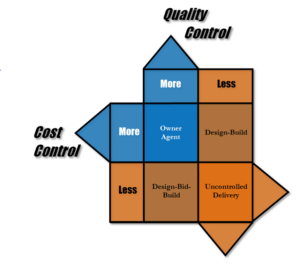
The diagram illustrates how each structure balances:
Cost Control (horizontal axis)
Quality Control (vertical axis)
In general:
Design–Build
Concentrates responsibility under one contract, which can simplify coordination but may reduce independent quality visibility while maintaining tighter cost alignment.
Design–Bid–Build
Increases cost control through competitive bidding, while quality control depends heavily on complete and coordinated documentation.
Owner’s Agent
Positions the owner for greater control across both cost and quality through independent oversight.
Uncontrolled Delivery
Occurs when structure is weak or undefined — reducing control of both cost and quality.
The structure you choose determines:
- How cost pressure is managed
- How quality decisions are protected
- How transparent pricing remains
- How communication flows under pressure
Structure shapes behavior.
Choose intentionally.
🧭 What Comes Next
Teams define who participates.
Delivery structure defines how authority and communication flow between them.
Before selecting a structure, you must understand how Planning and Design establish scope clarity.