
Project Teams
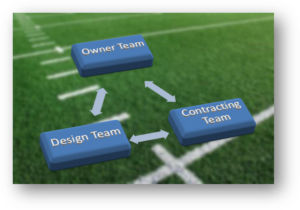
Every project involves three distinct teams:
- Owner Team
- Design Team
- Construction Team
Thinking in teams — not individuals — clarifies responsibility and motivation.
Construction projects operate like coordinated teams on a field.
Roles are defined. Incentives differ. Strategy affects management.
Each team brings its own priorities to the field.
Alignment does not happen automatically — it is managed.
Team Motivations
At first glance, it may seem that everyone simply wants the project completed.
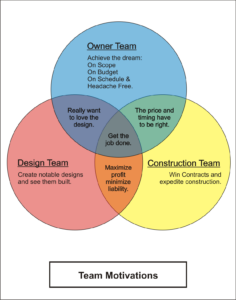
But look closely at the Team Motivations diagram.
Each team operates under different pressures:
Owner Team
- Achieve the dream
- Stay on budget
- Stay on schedule
- Reduce risk
Design Team
- Create notable designs
- Protect professional reputation
- Earn design fees
Construction Team
- Deliver safely
- Complete efficiently
- Earn profit
- Protect margins
At the center, all three share one common goal:
- Get the job done.
But outside that center, motivations diverge.
Some overlap.
Some compete.
Some directly conflict under pressure.
Understanding this matters because:
- Contracts formalize these motivations.
- Incentives influence behavior.
- Pressure reveals priorities.
When schedule tightens or budget compresses, teams default to protecting their core motivations.
Alignment under pressure is engineered, not assumed.
Successful projects do not assume alignment.
They manage it.
Team Members
Each team is made up of multiple professionals and organizations.
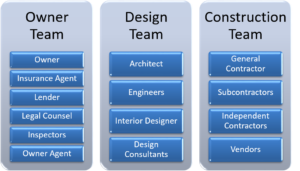
The Owner Team may include:
- The Owner
- Insurance Agent
- Lender
- Legal Counsel
- Inspectors
- Owner’s Representative
The Design Team may include:
- Architect
- Engineers
- Interior Designer
- Design Consultants
The Construction Team may include:
- General Contractor
- Subcontractors
- Independent Contractors
- Vendors
Each of these participants carries:
- Defined authority
- Defined contractual obligations
- Defined risk exposure
But authority does not always equal control.
And responsibility does not always equal alignment.
Understanding who belongs to each team — and how they relate contractually — allows you to:
- Clarify decision pathways
- Reduce communication breakdowns
- Prevent responsibility gaps
Most project friction begins not because people are incompetent — but because roles and expectations are misunderstood.
Continue Within the Overview
If you want deeper insight into team roles and responsibilities, explore:
Understanding delivery structure will further clarify how authority and communication flow through a project.
What Comes Next
Teams define who participates.
Delivery structure defines how they interact.
Understanding project delivery methods clarifies how communication, authority, and risk are formally organized.